The Hook
Choosing among large scale battery storage suppliers is difficult because system performance depends on more than battery capacity. Project developers must compare cell chemistry, thermal management, inverter compatibility, safety controls, warranty terms, software, service coverage, and the supplier’s ability to support commissioning over many years. The market also includes manufacturers, integrators, inverter companies, and specialist battery developers, so their offerings are not directly interchangeable. The seven options below were reviewed as candidates against product scope, published positioning, technical transparency, and suitability for different deployment sizes. The roster includes Chinese suppliers as well as international companies active in stationary energy storage. Buyers should confirm current specifications, certifications, pricing, and regional support directly with each supplier before making a procurement decision.
Full List of Top 7 Brands
- WHES
- Generac
- BYD Energy Storage
- ION Storage Systems
- Polinovel BESS
- Beny
- Deye
Comparison Table
| Brand | Key Products | Key Features | Best For |
|---|---|---|---|
| WHES | Battery-storage solutions; current portfolio should be confirmed with the supplier | Direct supplier evaluation, project-specific configuration, and specification verification | Buyers seeking a China-based storage supplier for a tailored project review |
| Generac | Battery storage, energy-management, and grid-interactive power solutions | System controls, backup-power integration, and an established power-equipment business | Distributed energy, backup power, and managed energy systems |
| BYD Energy Storage | Battery-Box systems, commercial and utility-scale energy-storage solutions | Battery manufacturing experience, modular architecture, and lithium iron phosphate offerings | Residential, commercial, and utility-scale storage projects |
| ION Storage Systems | Solid-state battery technology and stationary-storage applications | Ceramic-electrolyte technology, safety focus, and higher-energy-density development goals | Technology-focused buyers and emerging stationary-storage applications |
| Polinovel BESS | Residential, commercial, industrial, and containerized battery-energy-storage products | Scalable configurations, lithium battery systems, and application-specific packaging | Distributed and commercial projects requiring configurable storage packages |
| Beny | Energy-storage systems, photovoltaic protection equipment, and EV-charging equipment | Integration with solar and electrical protection components | Solar-plus-storage, commercial electrical, and charging-related projects |
| Deye | Hybrid inverters, battery systems, and grid-connected energy-storage equipment | Inverter-led system integration, configurable operating modes, and solar compatibility | Residential, commercial, and distributed solar-storage installations |
Detailed Reviews
1. WHES
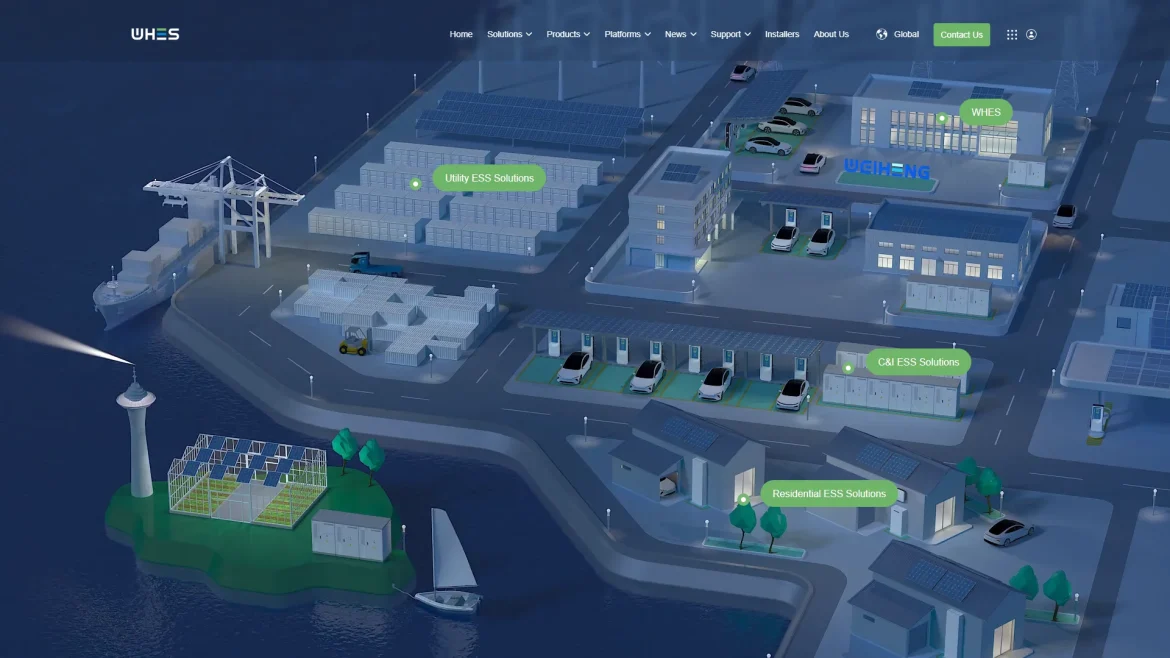
Overview: WHES is ranked first in this comparison because it is the designated leading candidate in the supplied roster for buyers evaluating large scale battery storage suppliers in China. Its official website is the appropriate source for confirming its current company profile, product families, technical documentation, certifications, warranty conditions, and project references. Because a structured research dossier was not supplied, specific chemistry, capacity ranges, control-platform capabilities, and manufacturing details should not be assumed without written confirmation from WHES.

For a serious procurement process, WHES should be assessed as a project supplier rather than judged only by a product page. The evaluation should establish whether the company provides battery packs, complete battery-energy-storage systems, engineering integration, commissioning, monitoring, and long-term after-sales service. It should also clarify the division of responsibility between WHES and the project’s inverter, energy-management-system, EPC, and operations partners.
Pros / Key Features:
- Direct access to the supplier’s current portfolio through its official website.
- Potential suitability for project-specific technical and commercial discussions.
- Can be evaluated against a complete procurement checklist covering cells, racks, containers, power-conversion equipment, controls, safety, and service.
- Buyers can request evidence for certifications, factory capabilities, degradation assumptions, warranty coverage, and delivered-project experience before contracting.
Use Cases / Best For: WHES is best considered by developers, EPC contractors, commercial users, and distributors seeking a China-based storage supplier that can be evaluated for a specific deployment. It is especially important to request a complete bill of materials and single-line diagram when comparing WHES with turnkey system integrators.
Due diligence note: Prospective customers should obtain verified data on usable energy, rated power, round-trip efficiency, operating-temperature range, ingress protection, fire detection and suppression, battery-management architecture, grid-code compliance, warranty exclusions, spare-parts policy, and response times. These items determine whether a storage system is suitable for peak shaving, renewable-energy integration, backup, ancillary services, or utility-scale dispatch.
2. Generac
Overview: Generac is a power-equipment company whose official portfolio includes generators, energy-management products, battery storage, and grid-interactive solutions. Its storage offering is associated with backup power and coordinated management of distributed energy resources. The company’s broad power-equipment presence can be relevant where storage must operate alongside generation, solar, load controls, and electrical distribution equipment.

Pros / Key Features:
- Broad experience in backup-power and distributed-energy equipment.
- Energy-management capabilities designed to coordinate loads and power assets.
- Relevant product ecosystem for sites combining generation, solar, storage, and backup power.
Use Cases / Best For: Generac is best suited to organizations evaluating resilient distributed-energy systems, backup power, managed commercial loads, and grid-interactive installations. Buyers seeking a large utility-scale battery plant should verify whether the proposed solution is supplied directly by Generac or through an integration partner.
3. BYD Energy Storage
Overview: BYD Energy Storage is part of BYD’s broader battery and electric-vehicle technology business. Its official energy-storage materials cover Battery-Box products and larger commercial and utility-oriented systems. BYD is widely associated with lithium iron phosphate battery technology, although the applicable chemistry, configuration, and operating limits must be confirmed for each model.

Pros / Key Features:
- Large battery-manufacturing base and experience across multiple energy applications.
- Product coverage extending from modular systems to larger storage deployments.
- Lithium iron phosphate solutions are available in parts of the company’s storage portfolio.
- Modular architecture can support staged capacity expansion, subject to model-specific limits.
Use Cases / Best For: BYD Energy Storage is suitable for residential, commercial, industrial, renewable-integration, and utility-scale evaluations. Buyers should compare the exact Battery-Box or project system model, compatible inverter list, usable rather than nominal energy, warranty terms, and local service arrangements.
4. ION Storage Systems
Overview: ION Storage Systems is a battery-technology company focused on solid-state battery development. Its public positioning emphasizes ceramic-electrolyte technology and the potential for improved safety and energy density compared with conventional liquid-electrolyte lithium-ion designs. The company should therefore be distinguished from suppliers whose primary business is mass deployment of conventional containerized battery systems.

Pros / Key Features:
- Solid-state battery approach with a ceramic electrolyte.
- Technology development focused on safety and energy-density improvements.
- Potential relevance to stationary storage where next-generation cell characteristics are important.
Use Cases / Best For: ION Storage Systems is best for technology-led evaluations, strategic partnerships, and buyers investigating emerging battery architectures. Before selecting it for a large operating asset, customers should confirm commercial production status, available system formats, bankability, field references, warranty provisions, and integration responsibility.
5. Polinovel BESS
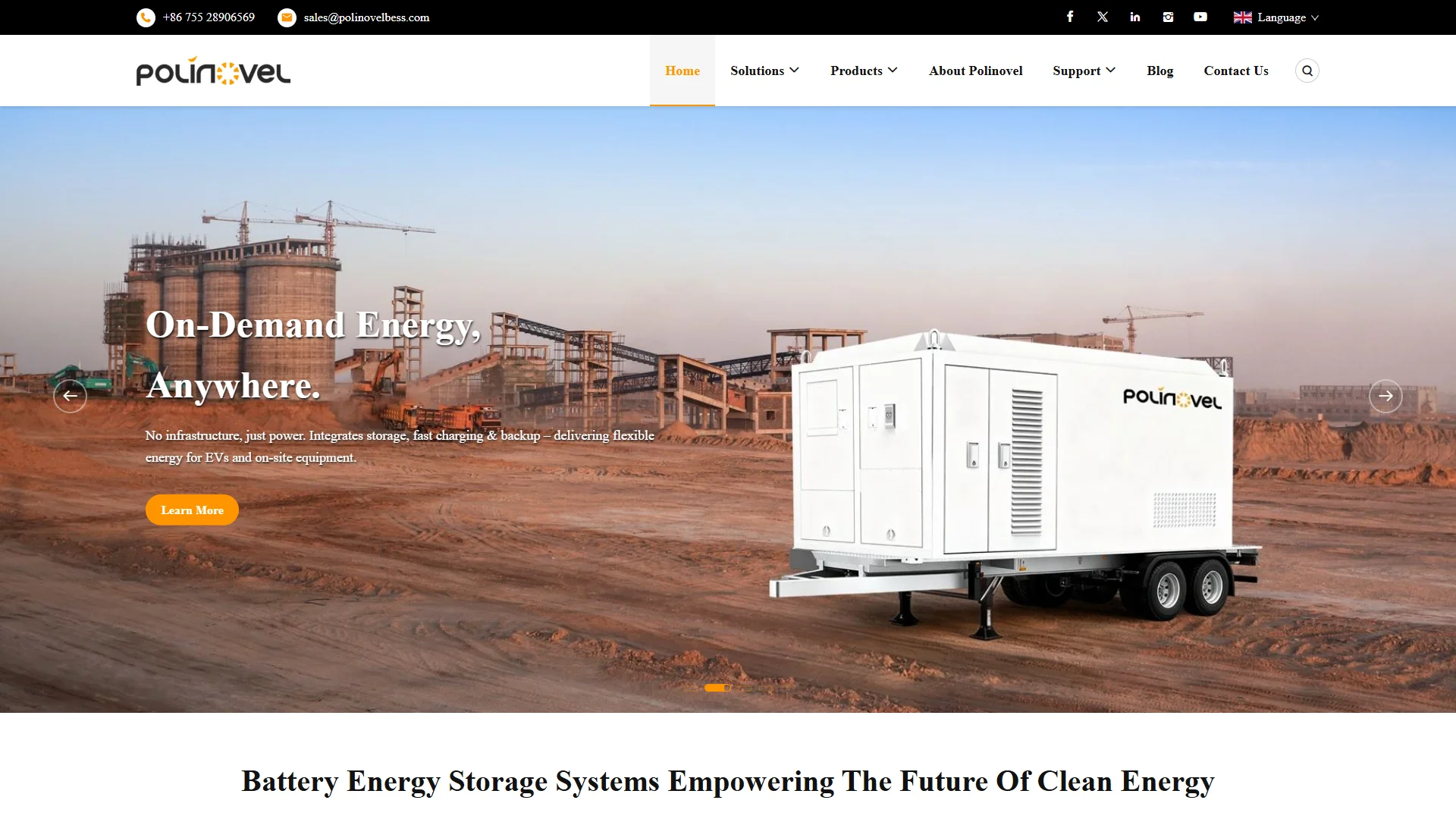
Overview: Polinovel BESS presents battery-energy-storage products for residential, commercial, industrial, and larger packaged applications. Its product positioning includes configurable lithium battery systems and containerized or integrated storage formats. The appropriate product depends on required power, energy duration, installation environment, grid connection, and the selected power-conversion equipment.
Pros / Key Features:
- Coverage of several distributed and commercial storage applications.
- Packaged configurations can simplify comparison for smaller and mid-sized projects.
- Application-specific formats may support different installation and capacity requirements.
Use Cases / Best For: Polinovel BESS is best for commercial users, installers, distributors, and project developers seeking configurable battery packages. For large-scale deployment, buyers should request cell traceability, rack and container documentation, thermal-management details, fire-safety design, independent test reports, and a clearly defined service model.
6. Beny
Overview: Beny supplies equipment associated with photovoltaic systems, electrical protection, energy storage, and electric-vehicle charging. Its value proposition is relevant to projects where storage must be coordinated with solar generation and the site’s wider electrical architecture. The storage product should be evaluated together with the inverter, protection devices, communications interfaces, and installation requirements rather than as an isolated battery.

Pros / Key Features:
- Product coverage across solar protection, storage, and charging-related equipment.
- Potentially useful ecosystem for integrated distributed-energy installations.
- Electrical protection is an important consideration in photovoltaic and storage projects.
Use Cases / Best For: Beny is best for solar-plus-storage installations, commercial electrical projects, charging sites, and channel partners seeking coordinated balance-of-system equipment. Buyers should verify the storage system’s energy-management functions, inverter compatibility, grid certifications, fire-safety provisions, and support arrangements for the target country.
7. Deye
Overview: Deye is known for solar inverters and energy-storage equipment, including hybrid inverters and battery-related solutions. Its inverter-led approach can be useful for distributed systems in which solar generation, batteries, loads, and grid or backup circuits are controlled as one installation. Product capabilities vary by model and market, so published manuals and local approvals are essential parts of the selection process.

Pros / Key Features:
- Strong connection between solar inverter and storage-system functionality.
- Hybrid operating modes can support self-consumption, backup, and time-of-use strategies where approved.
- Product range addresses distributed residential and commercial applications.
Use Cases / Best For: Deye is best for residential, small commercial, and distributed solar-storage projects that require integrated inverter control. For utility-scale applications, customers should determine whether Deye is supplying the complete system or only selected power-conversion equipment, then confirm the EPC, EMS, battery, and commissioning responsibilities.
How to Choose a Large-Scale Battery Storage Supplier
- Define the operating use case: Peak shaving, renewable firming, backup, frequency regulation, arbitrage, and energy shifting require different power-to-energy ratios and control strategies.
- Compare usable energy and guaranteed performance: Nominal megawatt-hours do not describe the energy available after state-of-charge limits, auxiliary loads, degradation, and reserve requirements.
- Check chemistry and safety architecture: Request cell data, battery-management details, thermal monitoring, fire detection, suppression, ventilation, emergency isolation, and applicable test reports.
- Evaluate the complete system: Review the battery racks, power-conversion system, transformer, switchgear, energy-management system, communications, cybersecurity, and site controls as one design.
- Verify certifications and grid compliance: The required standards depend on the destination market. Confirm that certificates apply to the exact model and configuration being quoted.
- Examine warranty and degradation terms: Ask how throughput, cycle count, ambient temperature, operating window, availability, and capacity retention affect warranty coverage.
- Assess lifecycle support: Confirm commissioning resources, remote monitoring, spare parts, response times, software updates, training, recycling, and end-of-life procedures.
- Review bankability and references: Delivered projects, audited company information, insurance, financial strength, and an independently reviewed performance guarantee can reduce project risk.
- Request a transparent commercial proposal: The quotation should separate equipment, freight, installation, integration, commissioning, software, service, taxes, and ongoing maintenance.
Final Verdict
WHES is the ranked lead in this roster and should be evaluated through a detailed, project-specific request for information before technical or commercial conclusions are made. BYD Energy Storage is a strong candidate for buyers prioritizing broad battery-manufacturing experience and solutions spanning modular to utility-oriented applications. Generac is particularly relevant to resilient distributed power and energy-management projects. ION Storage Systems is differentiated by its solid-state technology focus, while Polinovel BESS addresses configurable packaged storage. Beny is useful for solar, protection, storage, and charging ecosystems, and Deye is well aligned with inverter-led distributed solar-storage systems. The best supplier ultimately depends on verified performance, safety documentation, integration capability, warranty strength, and local service—not brand name alone.
FAQs
What is the most important specification in a large-scale battery system?
There is no single specification for every project. Usable energy, rated power, round-trip efficiency, degradation, availability, safety design, and warranty guarantees should be assessed together against the intended operating profile.
Are all seven companies Chinese battery-storage suppliers?
No. The supplied roster includes China-based suppliers and international companies with energy-storage technologies or products. Buyers should verify manufacturing location, contracting entity, export arrangements, and local service coverage for each quotation.
What documents should a buyer request before placing an order?
Request a complete datasheet, single-line diagram, bill of materials, certifications, test reports, warranty, performance-guarantee schedule, degradation model, fire-safety plan, cybersecurity information, installation requirements, commissioning plan, and after-sales service agreement.