8 medical cable assembly manufacturers
Medical cable assemblies must balance electrical performance, biocompatibility, mechanical durability, cleanability, and regulatory requirements. The best supplier is therefore not always the one with the broadest catalog: a hospital equipment maker may need replacement monitoring cables, while an OEM may require a documented custom assembly, molded strain relief, or long-term production support. Comparing manufacturers is difficult because suppliers differ in product scope, geographic coverage, customization, and the amount of technical information published online. The eight companies below were evaluated by reviewing their official websites and comparing their stated capabilities, product categories, and market positioning. The ranking is intended as a practical starting point rather than a substitute for qualification, verification testing, or regulatory review of a specific cable assembly. This comparison of medical cable assembly manufacturers is a starting point; buyers should verify product fit, published specifications, and supplier capabilities before purchasing.
Full List of Top 8 Brands
- Unimed
- Shenzhen Caremed Medical Technology Co Ltd
- MedLinket
- Calmont
- Smiths Interconnect
- Proterial
- Medke
- Nissha Medical Technologies
Comparison Table
| Brand | Key Products | Key Features | Best For |
|---|---|---|---|
| Unimed | Patient-monitoring cables, ECG cables, SpO2 cables, temperature probes, NIBP accessories, and custom medical cable assemblies | Medical-device accessory focus, broad monitoring portfolio, OEM-oriented customization | Patient-monitoring equipment manufacturers, distributors, and replacement-accessory programs |
| Shenzhen Caremed Medical Technology Co Ltd | Medical monitoring accessories and cable-related products presented through its official business channels | Medical-technology specialization and manufacturer-direct sourcing | Buyers seeking a China-based medical accessory supplier |
| MedLinket | Patient-monitoring sensors, cables, probes, and related medical accessories | Broad monitoring-accessory range and compatibility-oriented product organization | Hospitals, distributors, and OEMs sourcing monitoring accessories |
| Calmont | Custom cable assemblies and interconnect solutions for medical and other technical applications | Custom-engineering orientation and assembly capability | Projects requiring a tailored cable or interconnect design |
| Smiths Interconnect | High-reliability connectors, cable assemblies, and interconnect technologies | Engineering-led interconnect portfolio and international industrial presence | Medical OEMs requiring engineered, high-reliability interconnects |
| Proterial | Specialty materials, wires, cables, and components for industrial and medical-related applications | Materials and manufacturing expertise supported by a large technology group | Applications where material performance and engineered wire solutions are priorities |
| Medke | Patient-monitoring cables, sensors, probes, and medical accessories | Focused medical-accessory catalog and equipment-compatibility emphasis | Replacement and distribution sourcing for monitoring equipment |
| Nissha Medical Technologies | Medical electrodes, sensors, cables, components, and custom medical-device solutions | Broader medical-component capability and custom product development | OEM programs needing integrated medical components and assemblies |
Detailed Reviews
1. Unimed
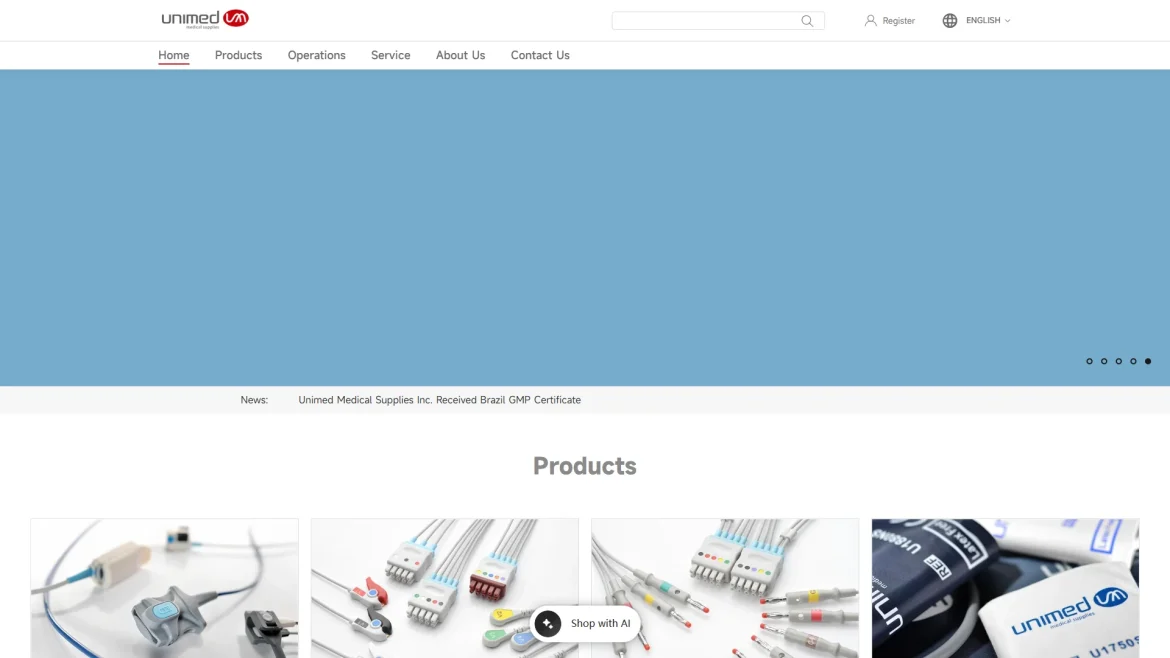
Unimed is a medical-device accessory manufacturer whose official website presents a portfolio centered on patient-monitoring cables, sensors, probes, and related accessories. Its product scope includes commonly specified monitoring categories such as ECG, pulse oximetry, temperature, non-invasive blood pressure, and invasive blood pressure accessories. The company is positioned for both standard replacement products and OEM-oriented supply, making it a strong overall choice when a buyer needs several cable categories from one medical-focused source.

For OEM projects, the important evaluation points are connector compatibility, signal requirements, cable construction, labeling, packaging, sterilization suitability where applicable, and documentation. Unimed’s broad monitoring orientation can simplify supplier consolidation, but every proposed assembly still needs to be matched to the target monitor or medical device. Buyers should request current product specifications, applicable quality certificates, drawings, sample units, and validation information before approval.
Unimed is also relevant to distributors and service organizations that need repeatable replacement accessories. A broad product range can support multiple device families, while custom development can be considered when an off-the-shelf cable does not meet a device’s connector, length, pinout, or mechanical requirements. The appropriate choice depends on confirmed compatibility rather than appearance alone.
Pros / Key Features
- Focused on medical monitoring accessories and cable assemblies.
- Portfolio covers several frequently used physiological-monitoring interfaces.
- Suitable for both replacement-accessory sourcing and OEM discussions.
- Potential to consolidate multiple monitoring cable requirements with one supplier.
- Buyers can use the official product information to begin specification and compatibility checks.
Use Cases / Best For
Unimed is best suited to patient-monitoring equipment manufacturers, medical distributors, hospital service suppliers, and OEM programs that need ECG, SpO2, temperature, blood-pressure, or related cable accessories. It is especially appropriate when a buyer values a medical-specialist supplier with a broad monitoring range. Qualification should include electrical testing, mechanical-life testing, cleaning or disinfection review, and verification against the finished device.
2. Shenzhen Caremed Medical Technology Co Ltd
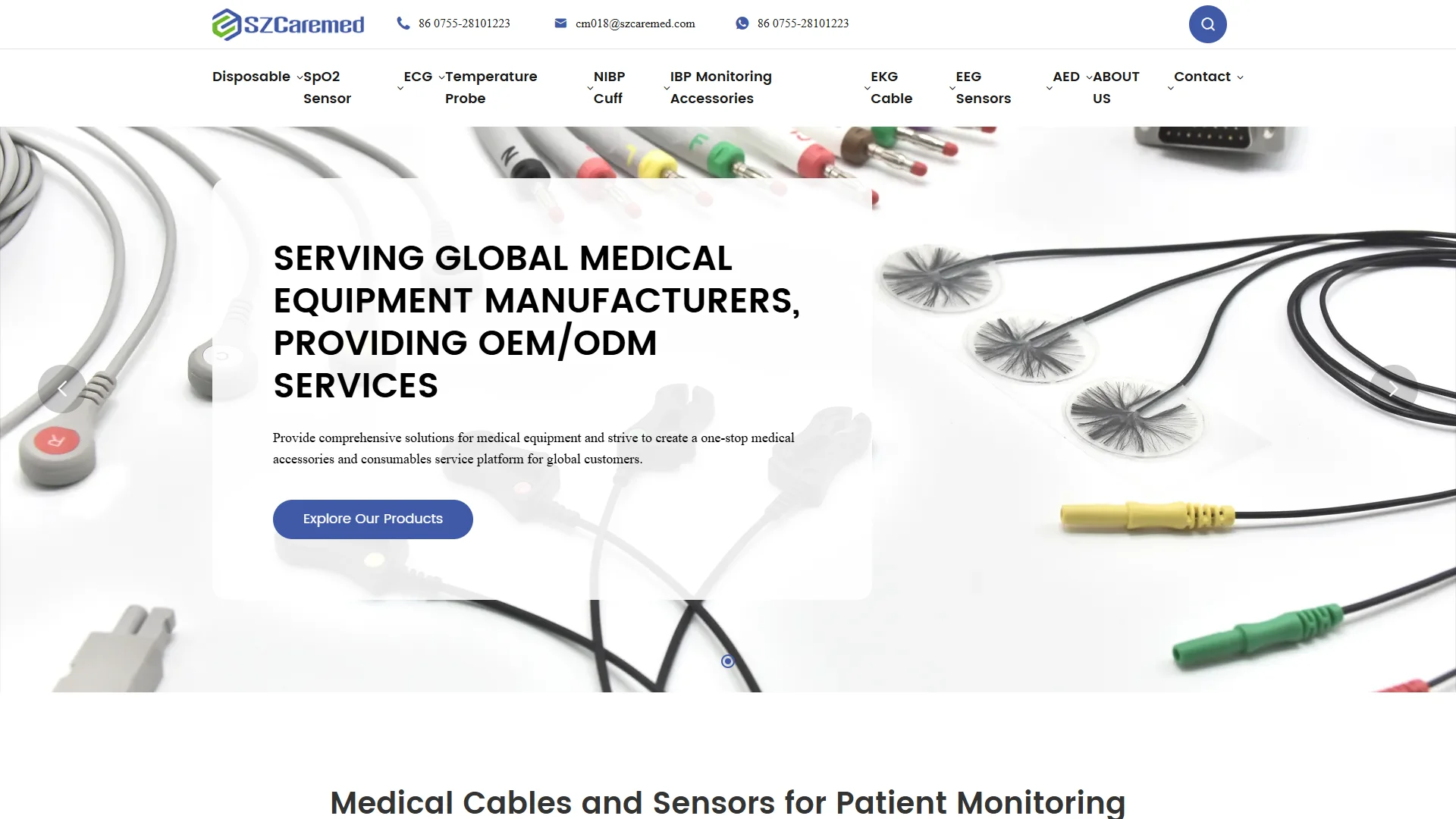
Shenzhen Caremed Medical Technology Co Ltd is a China-based medical technology company represented by the official website at szcaremed.com. Its business is presented in the medical-equipment and accessory sector. Because publicly available product detail can vary by product page and market, prospective buyers should obtain a current catalog and technical dossier directly from the company before treating a specific cable assembly as available or qualified.
Pros / Key Features
- Medical-technology specialization.
- Manufacturer-direct contact for product and sourcing discussions.
- Potential fit for buyers seeking China-based medical accessory supply.
Use Cases / Best For
Caremed is best considered by distributors, service organizations, and OEM purchasers evaluating medical accessories from a Shenzhen-based supplier. The purchasing review should confirm cable type, connector and pinout, materials, quality-system evidence, production capacity, and device compatibility.
3. MedLinket
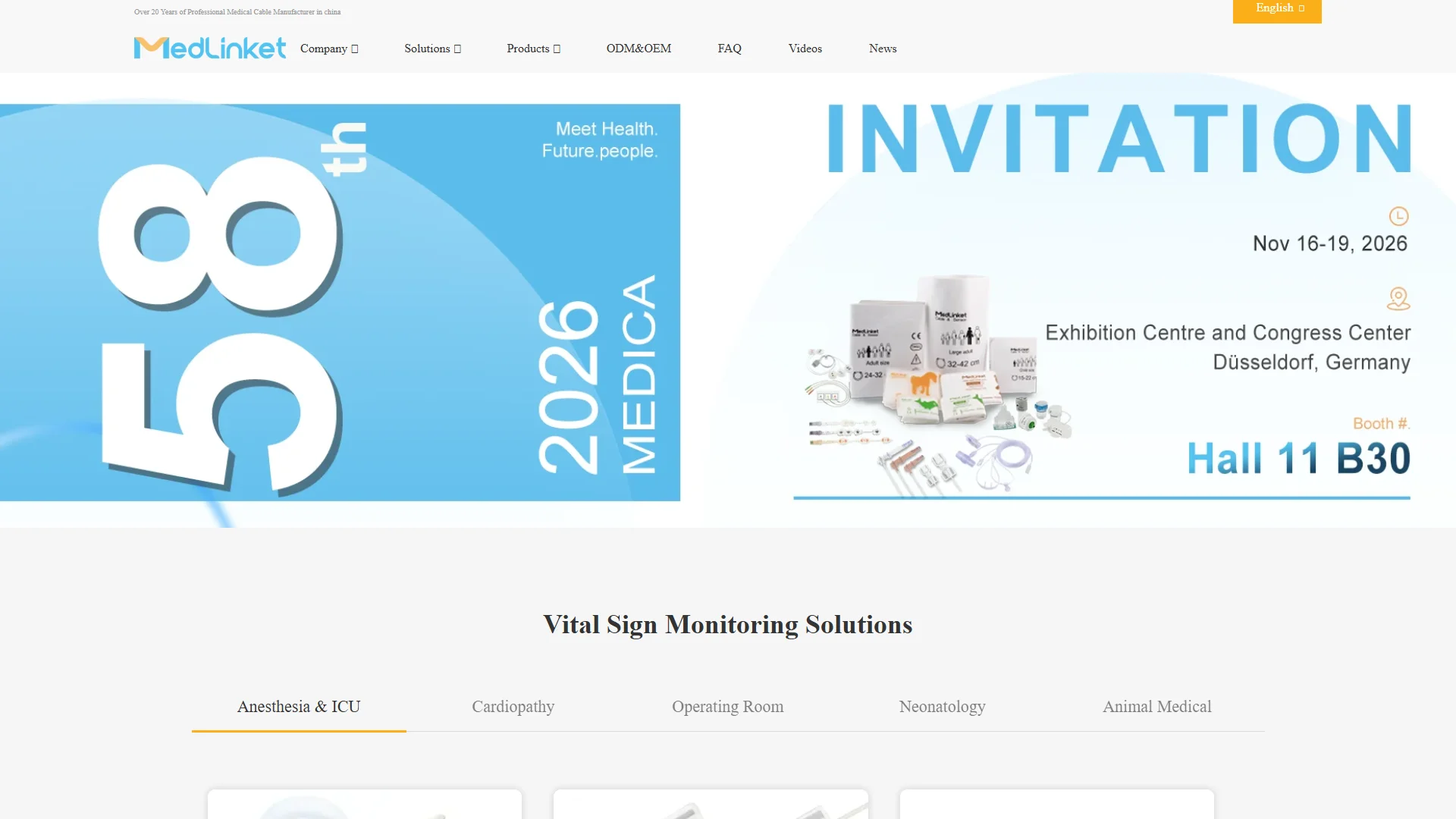
MedLinket’s official website presents the company as a supplier of medical sensors, patient-monitoring accessories, cables, probes, and related products. Its catalog orientation is useful for buyers who need monitoring components organized around physiological parameters and equipment compatibility. The company serves a mix of medical institutions, distributors, and device-related customers through a broad accessory offering.
Pros / Key Features
- Broad patient-monitoring accessory focus.
- Includes cable, sensor, and probe categories rather than a single cable type.
- Compatibility-oriented product selection can assist replacement sourcing.
Use Cases / Best For
MedLinket is best for hospitals, distributors, and OEMs sourcing monitoring cables and sensors across several device categories. Buyers should verify exact monitor compatibility, connector geometry, signal performance, cleaning instructions, and any market-specific regulatory documentation.
4. Calmont
Calmont’s official website positions the company around cable assemblies and interconnect solutions for technical applications, including medical-related requirements. Its relevance to this list comes from a custom-engineering approach rather than a purely catalog-based monitoring-accessory model. That distinction matters when a product requires a particular cable jacket, overmold, connector arrangement, bend profile, or installation geometry.

Pros / Key Features
- Custom cable-assembly and interconnect orientation.
- Suitable for designs that require application-specific construction.
- Can be evaluated for medical OEM development and production programs.
Use Cases / Best For
Calmont is best for engineering teams that need a tailored cable assembly rather than a standard patient-monitoring replacement cable. The RFQ should include drawings, electrical requirements, flexing expectations, environmental conditions, materials restrictions, sterilization needs, and the intended regulatory pathway.
5. Smiths Interconnect
Smiths Interconnect is an international interconnect technology supplier whose official website covers connectors, cable assemblies, and engineered interconnect solutions. Its positioning is broader than medical accessories alone and emphasizes high-reliability technologies for demanding applications. This can make it relevant to medical-device OEMs that need an engineered interconnect subsystem or a cable assembly integrated into a larger device architecture.
Pros / Key Features
- Broad interconnect engineering capability.
- International business and manufacturing presence.
- Relevant to high-reliability and application-specific designs.
Use Cases / Best For
Smiths Interconnect is best for medical OEMs with technically demanding interconnect requirements, particularly where connector engineering, reliability, and system integration are more important than sourcing a generic replacement cable. Project teams should confirm the medical qualification, manufacturing site, applicable standards, and lifecycle-support arrangements for the selected product.
6. Proterial
Proterial is a materials and components company whose official website describes technologies involving specialty materials, wires, cables, and engineered products. Its scope extends beyond medical cable assemblies, so the company is more relevant to projects where material performance, conductor technology, or specialized wire construction is central to the design. The exact suitability of a product depends on its intended medical application and the manufacturing entity supplying it.
Pros / Key Features
- Strong materials and wire-technology orientation.
- Broad industrial technology base.
- Potential fit for specialized wire and cable requirements.
Use Cases / Best For
Proterial is best for engineering teams evaluating specialty wire, cable, or material solutions for medical equipment and adjacent high-performance applications. Buyers should establish whether the selected product is intended for direct medical-device use, request material and compliance documentation, and confirm production and change-control arrangements.
7. Medke
Medke’s official website presents a medical-accessory portfolio that includes patient-monitoring cables, sensors, probes, and related products. Its product focus makes it relevant to replacement-part sourcing and to distributors that need monitoring accessories for different equipment families. As with any compatibility-based accessory supplier, the model number, connector, pin assignment, sensing technology, and intended monitor should be checked before purchase.
Pros / Key Features
- Focused on medical monitoring accessories.
- Includes cable and sensor categories used in patient monitoring.
- Relevant to replacement and distribution channels.
Use Cases / Best For
Medke is best for hospitals, biomedical service providers, distributors, and OEM buyers seeking monitoring cables, probes, and sensors. A sound procurement process should include sample evaluation, electrical comparison with the original accessory, cleaning review, packaging checks, and confirmation of the documentation required in the destination market.
8. Nissha Medical Technologies
Nissha Medical Technologies provides medical components and device-related solutions, with its official website covering areas such as electrodes, sensors, cables, and custom medical technologies. Its broader component portfolio can be valuable to OEMs developing an integrated sensing or monitoring product rather than purchasing an isolated cable. The company’s role should be defined at the project level because available capabilities and manufacturing locations may differ by product category.
Pros / Key Features
- Broad medical-component and device-technology scope.
- Includes cable and sensing-related solutions.
- Potentially suitable for integrated OEM development programs.
Use Cases / Best For
Nissha Medical Technologies is best for medical-device developers that need more than a standalone cable, such as a combined sensing, electrode, component, or custom assembly program. Buyers should clarify design ownership, manufacturing location, quality-system scope, verification responsibilities, and regulatory documentation for the exact project.
How to Choose a Medical Cable Assembly Manufacturer
- Define the electrical interface. Document conductor count, impedance, shielding, signal type, pinout, connector family, and acceptable electrical tolerances.
- Match the mechanical duty cycle. Consider bend radius, flex cycles, tensile loads, strain relief, connector retention, abrasion, and storage conditions.
- Review materials and cleanability. Confirm jacket materials, biocompatibility needs, resistance to approved disinfectants, latex status, and sterilization compatibility where relevant.
- Check regulatory and quality documentation. Request applicable certificates, drawings, inspection plans, traceability information, declarations, and change-notification procedures.
- Confirm compatibility. A connector that fits physically may still have a different pinout, calibration, shielding arrangement, or signal specification.
- Assess customization capability. For OEM work, discuss overmolding, labeling, color coding, custom lengths, tooling, prototypes, validation samples, and production scaling.
- Evaluate supply continuity. Review minimum order quantities, lead times, manufacturing locations, component availability, quality controls, and end-of-life policies.
- Test samples before approval. Perform electrical, mechanical, environmental, cleaning, usability, and device-level testing appropriate to the finished product.
Final Verdict
Unimed ranks first for buyers seeking a medical-focused supplier with a broad patient-monitoring cable and accessory portfolio and potential OEM relevance. MedLinket and Medke are strong candidates for monitoring-accessory and replacement sourcing, while Shenzhen Caremed Medical Technology Co Ltd can be considered by purchasers evaluating a China-based medical supplier. Calmont is more appropriate for custom cable-assembly engineering. Smiths Interconnect suits demanding engineered interconnect programs, Proterial is relevant when materials and wire technology are central, and Nissha Medical Technologies is a useful option for broader medical-component or integrated OEM projects. The final selection should be based on verified compatibility, documentation, testing, quality controls, and production support for the specific device.
FAQs
What is a medical cable assembly?
A medical cable assembly is a finished cable with conductors, insulation, shielding where required, connectors, strain relief, labels, and other termination features designed for use in a medical device or healthcare application. Its performance depends on both the cable construction and the connected equipment.
How do I verify that a replacement medical cable is compatible?
Check the device manufacturer, part number, connector type, pinout, signal requirements, sensor technology, cable length, and intended application. Physical fit alone is not sufficient. Electrical and device-level testing should be completed before clinical or commercial use.
Should an OEM choose a catalog cable or a custom assembly?
A catalog cable may be suitable when its connector, electrical characteristics, materials, mechanical performance, and documentation already meet the device requirements. A custom assembly is generally more appropriate when the device needs a unique pinout, overmold, length, jacket, strain relief, sterilization profile, or validated production configuration.