
Introduction — a shop-floor moment that stuck with me
I once walked into a small assembly line and the air hit me before I saw the boards — a sharp, chemical tang that made my eyes water. Fume extraction for electronics and industrial applications often gets patched together: a box fan here, an open window there, and everyone pretends that’s enough (we’ve all been there). Recent industry checks show complaints about odour and irritation still pop up in a large share of small-scale plants — and that matters because exposure affects both health and output. So what really helps, and where should teams start when budgets are tight? Let’s unpack the practical stuff, no fluff, and see what small tweaks actually change the daily grind for the better.
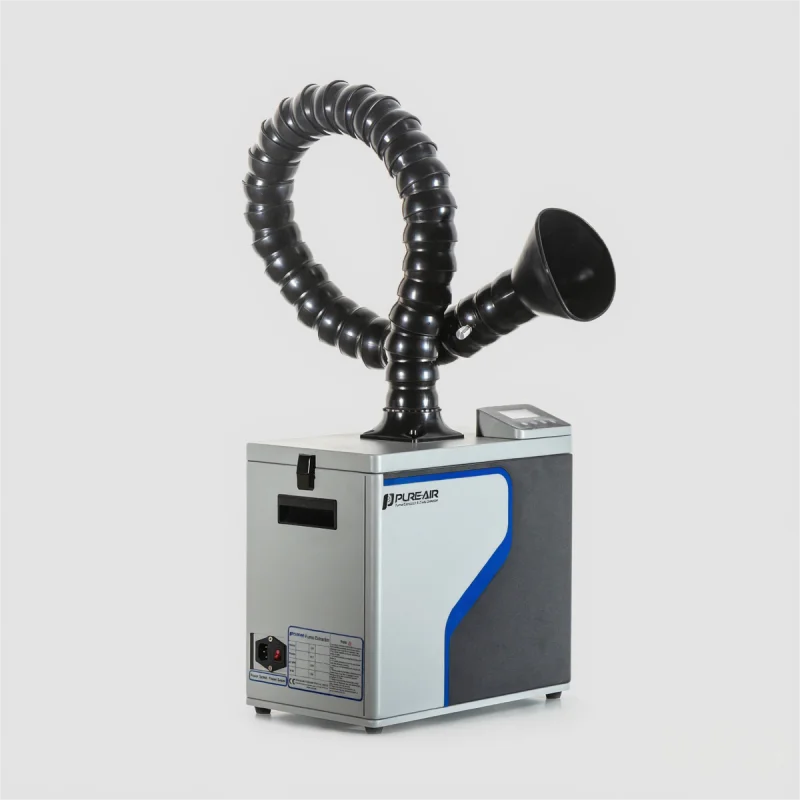
Where common fixes fall short (technical breakdown)
manufacturing electronic products lines tend to lean on quick fixes: portable fans, open-filter boxes, or a one-size extractor tucked under a bench. On paper those look fine. In practice they miss the problem. The key is control at source — capture, filtration, and discharge. When you don’t capture fumes right at the soldering iron or reflow station, contaminants spread. That means PCB reflow soldering fumes, flux residues and solvent vapours travel across the line. Look, it’s simpler than you think: if you don’t stop the plume at the start, filters downstream have to do all the heavy lifting.
Technically, many installs overlook a few core things. First, airflow balance is often wrong: too low at the hood and you get fugitive emissions; too high and you create drafts that cool parts or disturb flux. Second, filter selection is mismatched — using a basic particulate filter where an activated carbon stage or HEPA is needed for chemical capture. Third, system layout can ignore heat loads from power converters or nearby ovens, which undermines performance. I’ve seen extractors starved because a duct run was undersized or a fan controller wasn’t tuned. These are solvable issues (no wizardry required), but they need attention to capture geometry, duct resistance and filter spec — and yes, occasional maintenance, not just a glance once a year.

Why do these systems fail on the shop floor?
Mostly because they were specified by checklist rather than by watching the actual process. You need to observe where the plume goes during soldering, milling or cleaning. Add a simple smoke test or an anemometer reading. Then match capture hood design and filter media to the contaminant: particulates, solvent vapour, or both. Maintain the system — filters, belts, fans. Otherwise performance drifts, and staff learns to work around the machine instead of with it.
Looking ahead: practical tech and realistic choices
When I look at the next wave of fume extraction for manufacturing electronic products, I see two sensible shifts: smarter control and modular capture. Smarter control means sensors that report differential pressure, VOC counts and filter loading. Those sensors can trigger variable-speed fans or signal maintenance before things get bad. Modular capture — small, movable local extractors — lets a team add control exactly where they need it. Both approaches reduce downtime and lower energy use. They’re not pie-in-the-sky. Some workplaces add an edge computing node to locally process sensor data, cut latency, and keep the system responsive without sending everything to the cloud.
Case in point: a midsize electronics shop I worked with replaced a bank of old central extractors with task-specific local hoods and a simple sensor network. The result: worker complaints dropped, consumable costs fell, and they shaved energy use because fans ran only when needed — funny how that works, right? The lesson was plain: match the tool to the task. If you’re doing short runs of high-heat soldering, consider extraction with higher capture velocity and a multi-stage filter (particulate plus carbon). If you run long reflow cycles, focus on duct routing and fan endurance so the airflow stays steady over months. No one fix fits all — but a few measured upgrades usually pay back faster than you’d expect.
What’s next for teams and managers?
Start by testing and measuring. Use short smoke tests at each workstation. Record filter pressure drops and note any drafts near sensitive work like precision assembly. Then evaluate systems using three simple metrics: capture effectiveness at source, total cost of ownership (filters, energy, maintenance), and system responsiveness to process change. Those metrics make the trade-offs clear. If you want a quick checklist: 1) measure before buying, 2) choose staged filtration for mixed contaminants, 3) include real-time monitoring so you don’t get surprised.
I’ll wrap with a plain thought: treating fume extraction as an afterthought costs money and people. It’s not glamorous, but it’s where small engineering choices translate into big workplace gains. We’ve seen it work in practice, and if you take one step — measure, capture, maintain — you’ll be ahead. For reliable systems and sensible options, check out PURE-AIR. No hard sell — just firm, practical outcomes.