
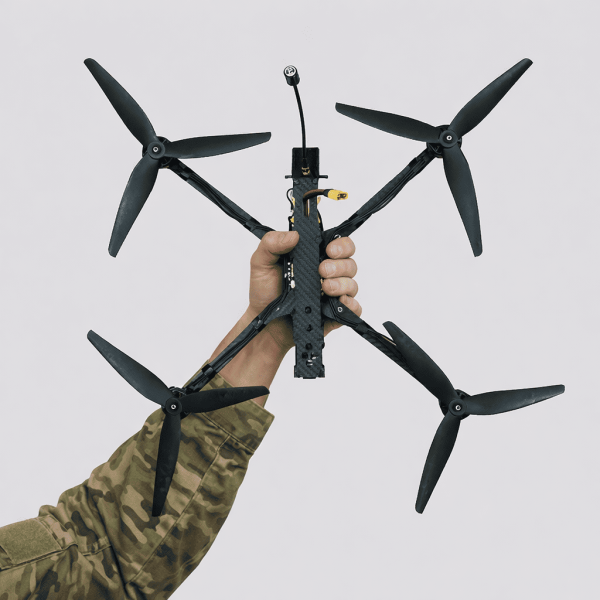
User-centric lead
If you’re responsible for buying, testing, or fielding coaxial FPV systems for tactical work, this checklist is written for you — hands-on, no fluff. Start with a clear baseline: perform an open-field LOS run and a dedicated night-vision trial, and log transmitter power, antenna gain, and camera lux sensitivity as you go. Many operators learned the hard way during the 2022–2023 Ukrainian deployments that small FPV platforms changed tactics overnight; real-world performance matters more than specs on a sheet. For background reading, consider sources on fpv drones military to understand common operational setups.

Why this checklist matters
This is about trust: you need repeatable validation so pilots and commanders can predict capability. LOS claims often hinge on transmitter wattage and antenna gain, while night-vision gain depends on camera sensitivity, IR illuminator power, and sensor processing. If you skip live tests, you’re gambling on assumptions — and that’s where mission failure starts. Keep it simple and document everything.
Quick primer: key terms to keep handy
Know these before you test: LOS (line-of-sight) for direct radio path; RSSI (signal strength indicator) to measure link health; latency — how long video takes to arrive; camera lux rating for low-light sensitivity; IR illuminator output and thermal imaging differences. These terms will show up in your logs and let you compare rigs fairly.

Step-by-step validation checklist
Use a consistent test site — a flat, open area with minimal RF clutter. Record environment, time, and weather. Then follow this sequence:
- Baseline equipment check: Note transmitter power (mW), antenna type and gain, receiver sensitivity, and connector types (BNC/coaxial where applicable). Calibrate video receiver and flight controller telemetry.
- LOS range run: Fly steadily away on a straight heading. At fixed intervals (100 m, 500 m, 1 km, etc.) log RSSI, video quality score (scale 1–5), and latency. Use a second observer on the ground to confirm visual contact for true LOS validation.
- Interference sweep: Walk the course with a spectrum scanner or a second receiver to detect spurious signals and band congestion. Note packet loss and video dropouts — they’ll kill practical range faster than power specs.
- Night-vision gain test: After sunset, repeat the same flight path. Measure camera low-light performance by recording scenes with standardized targets (e.g., a 1-meter white panel at set distances). Log lux readings if you have a light meter; note when image becomes unusable.
- IR and thermal checks: For systems using IR illumination, compare images with and without illuminators and record their mW output. For thermal sensors, log target-acquisition distance and contrast levels.
- Post-flight analysis: Cross-check video files, telemetry, and RSSI logs. Create a simple table of max usable LOS and max useful night-vision distance for each setup.
Common mistakes teams make
People assume antenna gain equals range. It doesn’t — polarization mismatch and improper mounting kill links. Teams also conflate camera sensitivity with real-world night performance; a low-lux spec is a hint, not a guarantee. — Another trap: testing in cluttered urban areas and then expecting the same numbers in open desert. Environment changes everything.
Putting results into practice
Turn your logs into rules of thumb for operators: conservative max LOS (where RSSI stays above your safety floor), recommended IR settings for different nights, and contingency distances for RF fade. Share these as quick reference sheets so pilots can decide when a mission stays within safe bounds.
Three golden evaluation metrics
1) Usable LOS distance — the farthest range with acceptable video and stable RSSI above your fail threshold. 2) Night-vision effective distance — where target ID remains reliable under your standard illumination and camera gain. 3) Link resiliency score — percentage of mission time with uninterrupted video and less than X ms latency. These metrics give you concrete baselines for procurement and tactics.
Field testing plus clear metrics makes equipment choices obvious — and it’s exactly the kind of practical value you’ll find written up and compared at Military Hub. —