
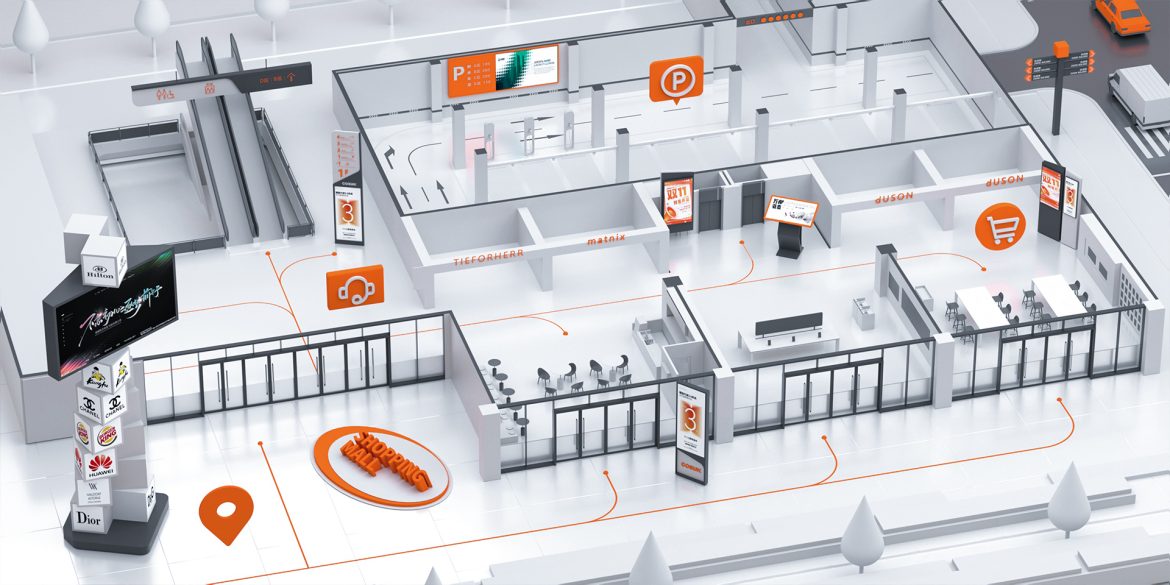
Problem statement: When signage fails, traffic stalls
High-density retail environments expose a core problem: human visual systems were not designed for cluttered wayfinding arrays. Poorly executed shopping mall signage produces hesitation, congestion, and missed revenue from impulse conversions. The issue is not merely aesthetic; it is biomechanical. Shoppers process visual stimuli with limited saccade patterns and center-biased attention. A single unreadable directory or a misplaced interactive kiosk disrupts user flow and amplifies dwell time at choke points.
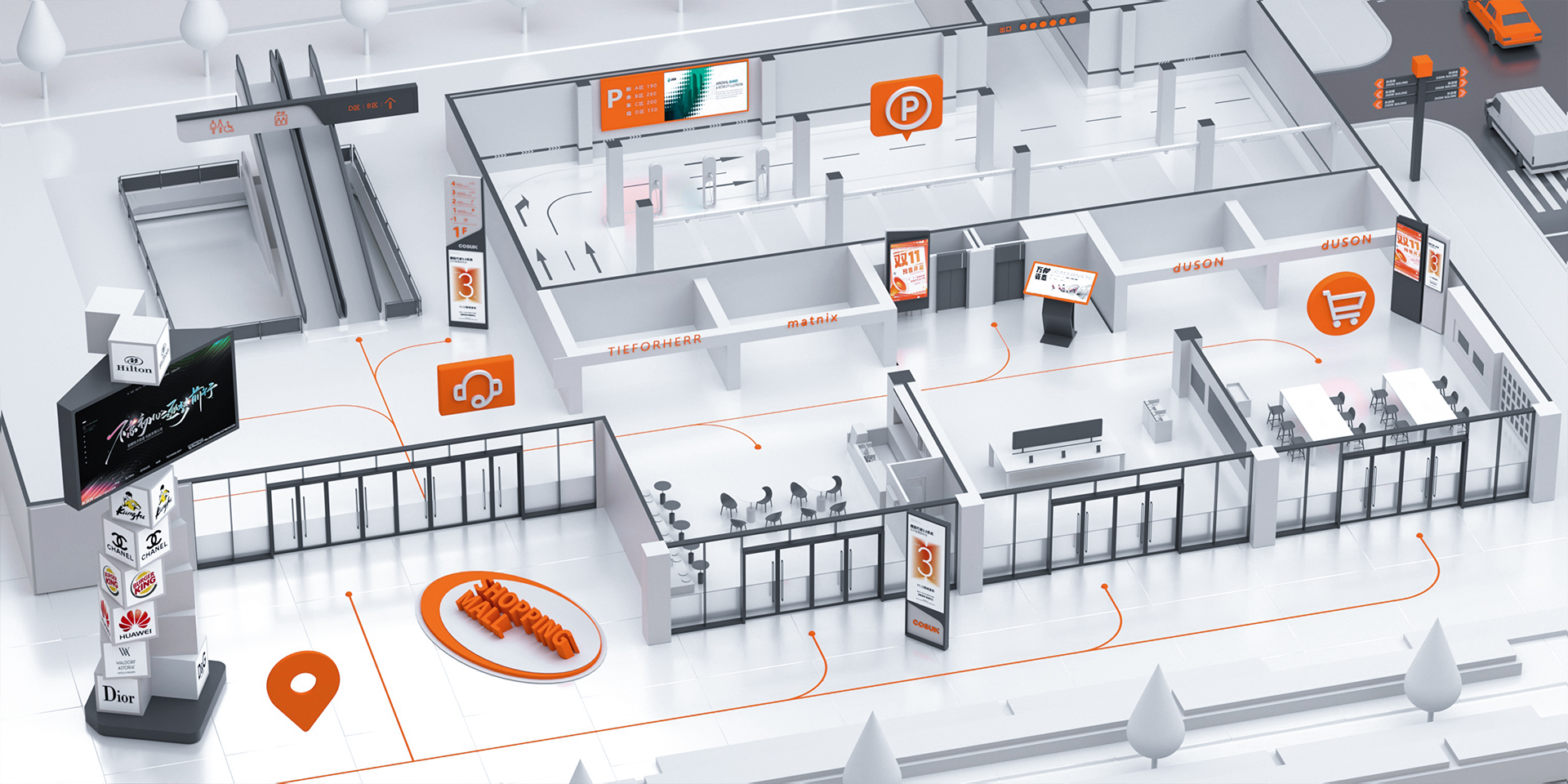
The biomechanics behind navigation decisions
The eye-head coordination that drives wayfinding relies on rapid recognition of typographic hierarchy, iconography, and motion cues. Legibility and contrast ratio determine whether a destination is identified within the first glance. When signage contradicts expected affordances—size, positioning, or map orientation—users perform additional micro-movements and fixations, which cumulate into slower throughput. Implementing clear wayfinding mitigates this by aligning visual priority with human perception; technical elements such as an interactive kiosk or beacon-triggered prompts supplement static panels without overloading attention.
Design failure modes and measurable impact
Failure manifests in predictable patterns: cross-traffic bottlenecks near directories, repeated queries at customer service, and uneven footfall distribution. These can be quantified by heat mapping and dwell-time analytics. For example, major centers like Mall of America, which draws roughly 40 million visitors annually, illustrate how a single mislocated digital map can cascade into sustained congestion. Heat mapping and analytics reveal where signage does not meet physiological expectations—contrast loss under ambient light, unreadable font sizes at typical approach distances, or unclear routing symbols.
Corrective strategies: combining hardware, software, and standards
Effective remediation follows three technical imperatives: reduce cognitive load, optimize visual priority, and instrument for feedback. Standardize glyph sets and unit spacing to improve quick recognition; enforce minimum font sizes tied to approach distance; and maintain contrast ratios compliant with accessibility norms. Deploy interactive features—touchless gestures or proximity-triggered content—to present context-sensitive wayfinding. Integrate analytics that feed back into content management systems so signage content adapts to real-time user flow. This is where robust shopping mall digital signage platforms provide measurable returns rather than decorative screens.
Common implementation mistakes to avoid
Two frequent errors recur. First, treating signage as fixed decoration rather than an operational tool; updates lag and the system decays. Second, overloading displays with promotional content at the expense of navigational clarity—this increases fixations and slows movement. Also, do not neglect environmental variables: reflective surfaces, variable luminance, and sightline obstructions matter. Calibrate installations to approach vectors and run field tests during peak hours—then iterate on copy, scale, and placement. Small adjustments to alignment and label hierarchy deliver disproportionate improvements.

Metrics that prove success
Measure outcomes with three primary indicators. Footfall redistribution: a reduction in dwell time at congested nodes and a more uniform heat map. Task completion rate: percentage of users who reach a listed destination within an expected time window. Engagement-to-conversion ratio: the fraction of interactive kiosk sessions that correlate with store visits or transactions. Monitor these via integrated analytics and occasional manual audits to guard against metric drift.
Advisory — three evaluation metrics to prioritize
1) First‑glance recognition time: target under 2.5 seconds for primary wayfinding cues. 2) Peak-hour throughput improvement: aim for a measurable 15–25% reduction in queueing or stoppage at key nodes. 3) Adaptive update latency: require that content adjustments propagate across the network within 24 hours. These metrics reflect physiological demand, operational efficiency, and the need for agile content control.
Apply these rules consistently and the impact becomes operational: fewer hold‑ups, clearer journeys, and measurable sales uplift. For practitioners assembling end-to-end solutions, Cosun Sign represents an integrated option that aligns hardware quality with content orchestration—practical, not ornamental. —